Analysis

The Family Business Crossroads.
By IfunanyaChukwu Onyema-NwankwoAug 1, 2026
The Family Business Crossroads.
(Okeke & Sons versus Camilleri & Nephews).
What Nigeria and Malta can teach each other about apprenticeship, stewardship, succession and scale Heritage builds trust. Systems preserve relevance.
A three-part strategic exposé for owners, heirs, boards and advisers. By IfunanyaChukwu Onyema-Nwankwo
| July 2026
Executive summary
Family businesses do not fail because they are family businesses. They fail when family identity is made substitute to strategy, governance and execution.
Nigeria and Malta reveal an instructive mirror image. Nigeria—most vividly through the apprenticeship system, often called Igba-Boi—can be exceptional at ground-up commercial formation: learning the customer, supplier, product and cash cycle from inside the trade. Yet many firms do not add equally robust formal management education, governance architecture or succession systems. Malta more often benefits from formal education, regulation and institutional discipline; yet an heir can be professionally qualified without having started at the counter, warehouse or delivery route where the business actually earns trust.
Both models become fragile when they remain incomplete. The Nigerian risk is a commercially fluent heir without the systems to govern scale. The Maltese risk is a formally trained heir without the appetite, tacit knowledge or ground-up experience to operate the enterprise. In both countries, the answer is neither hereditary entitlement nor compulsory inheritance. It is stewardship: ownership treated as a duty to preserve and improve an institution, whether the chief executive is family or non-family.
A family business becomes durable when apprenticeship builds judgement, education builds capability, governance builds transparency, and succession selects the person who can rightly chart the course of the institution and not merely carrying on the family name.
Seven conclusions
· Apprenticeship and formal business education are complements, not substitutes.
· Ownership, board oversight and executive management must be separated—even when the same people initially occupy all three roles.
· A stewardship mentality reinvests, protects optionality and measures withdrawals; a big-spender mentality treats the firm as a private cash machine.
· Succession should begin with interest and capability, not birth order. The first son can win the role, but must win it against a role specification.
· Diversification should follow shared capabilities, customers or economics. Brand stretch that confuses the promise can destroy an heirloom faster than competitive attack.
· Local identity may earn goodwill, but price, quality, convenience, delivery (speed and ease), trust, experience and sustainability determine repeat purchase.
· The owner’s goal should be a transparent operating system that performs with minimal day-to-day owner intervention and escalates only true exceptions.

Figure 1. The Nigeria–Malta capability mirror
Source: Oriental Strategy Analytics’s synthesis, informed by Irene et al. (2024), CeFEO and comparative observation.
Part I — The capability mirror
Nigeria: apprenticeship on point, institution-building uneven
Nigeria’s deepest family-business advantage is an indigenous method of commercial formation, the apprenticeship system. The Igbo apprenticeship system places the learner inside the daily mechanics of enterprise: buying, pricing, negotiation, credit, customer relations, inventory, risk and reputation. Recent research describes the system as mimetic and relational learning—knowledge and behaviour acquired through observation, participation and repeated practice rather than classroom instruction alone (Irene et al., 2024).
That ground-up formation produces something business schools struggle to simulate: commercial judgement under constraint. The apprentice sees what a late delivery does to trust, what dead stock does to cash, and how supplier terms affect survival. In its strongest form, the system also carries an ethic of enterprise multiplication, because a successfully completed apprenticeship may culminate in settlement or support to launch the apprentice into business ownership.
Its limitation is not the absence of intelligence. It is that tacit knowledge does not automatically become an institution. A founder can know the business intimately while the business itself runs on skeletal structure: no documented delegation of authority, no management accounts by unit, no independent board challenge, no family-employment policy, no risk register, no succession timetable and no transparent rule for dividends versus reinvestment.
This is the gap between a business that spreads through personal influence and one that scales through repeatable systems. The former can open branches; the latter can make those branches perform consistently without the founder inspecting every transaction.
The missing bridge: management education after apprenticeship
The prescription is not to replace Igba-Boi with an MBA, rather it is to build a bridge between them. Apprenticeship should be followed by a structured curriculum in financial literacy, working-capital management, strategy, governance, people leadership, technology, cybersecurity, compliance and capital allocation. The sequence matters: the classroom explains and generalises what the apprentice has already experienced; the business then becomes a laboratory in which formal concepts are tested.
A strong heir-development track would therefore include frontline rotations, formal education, an external work assignment, responsibility for a measurable transformation project, board exposure and an independently assessed readiness review. Family membership supplies context—not competence.
Malta: formal training on point, apprenticeship sometimes wobbly
Malta presents a different strength. Its EU environment, formal education pathways, compliance culture and professional-services ecosystem encourage structured business knowledge. Many next-generation family members can bring accounting, law, finance, management or technical qualifications into the enterprise. This is valuable, particularly as firms confront cyber risk, regulation, cross-border trade and digital investment.
Yet qualifications can create a false sense of readiness when the heir has not learned the business from the ground up. A family member who enters at director level may understand strategy in the abstract while missing the tacit operating logic carried by long-serving staff: which customers pay late but remain valuable, which seasonal products pull footfall, why a particular supplier is tolerated, or which service ritual sustains the brand.
Ground-up apprenticeship is an information-acquisition system. The purpose of starting close to the customer and the work is to understand where value is created, where it leaks, and how employees experience decisions made at the top.
The Maltese dilemma is sometimes sharper: a capable heir may simply want a different life. That is not a moral failure. Compelling an uninterested family member to operate the business can prove destructive. The objective should be continuity of stewardship, not compulsory continuity of occupation.
The retail warning: when loyalty meets scale economics
Malta’s grocery landscape illustrates why heritage cannot be treated as a moat. Larger supermarket and discount formats can spread procurement, warehousing, marketing, technology and compliance costs across very large volume. They can fund broader assortments, private labels, parking, extended opening hours, delivery, loyalty programmes, coupons and cross-category offers that generate more foot traffic. This does not mean every chain is automatically better; it means its economic system gives it more ways to compete.
Ambrose General Store in San Ġwann is the clearest cautionary case. The store closed after 48 years. Its owners traced the deterioration from the early 2000s to the growth of supermarkets, grocery chains and discount outlets; their children were not interested in continuing. Reporting around the closure also cited Malta’s 2024 Family Business Survey: 67% of family businesses lacked a written strategic plan and 65% lacked a formal succession plan (Times of Malta, 2026a).
Wembley Store in Valletta requires a more careful reading. It closed in 2025 after 101 years and three generations, but its owners characterised the decision as voluntary and the family legacy as fulfilled. Supermarkets had affected business, though not critically; the store had already moved away from mass grocery towards speciality food and wine. Its story is therefore not a simple tale of chain competition. It is a case about retirement, strategic repositioning and the legitimate choice to conclude a family operating chapter with dignity (Times of Malta, 2025).
Closures are evidence of changing economics and succession choices—not proof of a single cause. Ambrose shows competitive pressure plus weak succession. Wembley shows adaptation plus an intentional exit.
Nigeria: patriotism is not a value proposition
Nigeria has used local-content policy and public campaigns to encourage domestic participation and consumption. Public messaging such as “Buy Naija to Grow the Naira” has aimed at the consumer side of the equation. The Nigerian Oil and Gas Industry Content Development Act 2010 provides a substantive sector-specific framework for building Nigerian capacity.
But a family business should not confuse policy support with customer obligation. Nigeria remains deeply integrated into global trade, and imported goods compete across categories. The strategic issue is not whether consumers are sufficiently patriotic; it is whether the local offer wins the full choice-mix under real household pressure.
Consumers weigh price, quality, availability, delivery time, convenience, packaging, status, trust, reviews, experience, trend fit and increasingly sustainability. Indigenous ownership can strengthen authenticity and emotional connection, but it cannot compensate indefinitely for stock-outs, inconsistent quality, weak service or poor digital access.
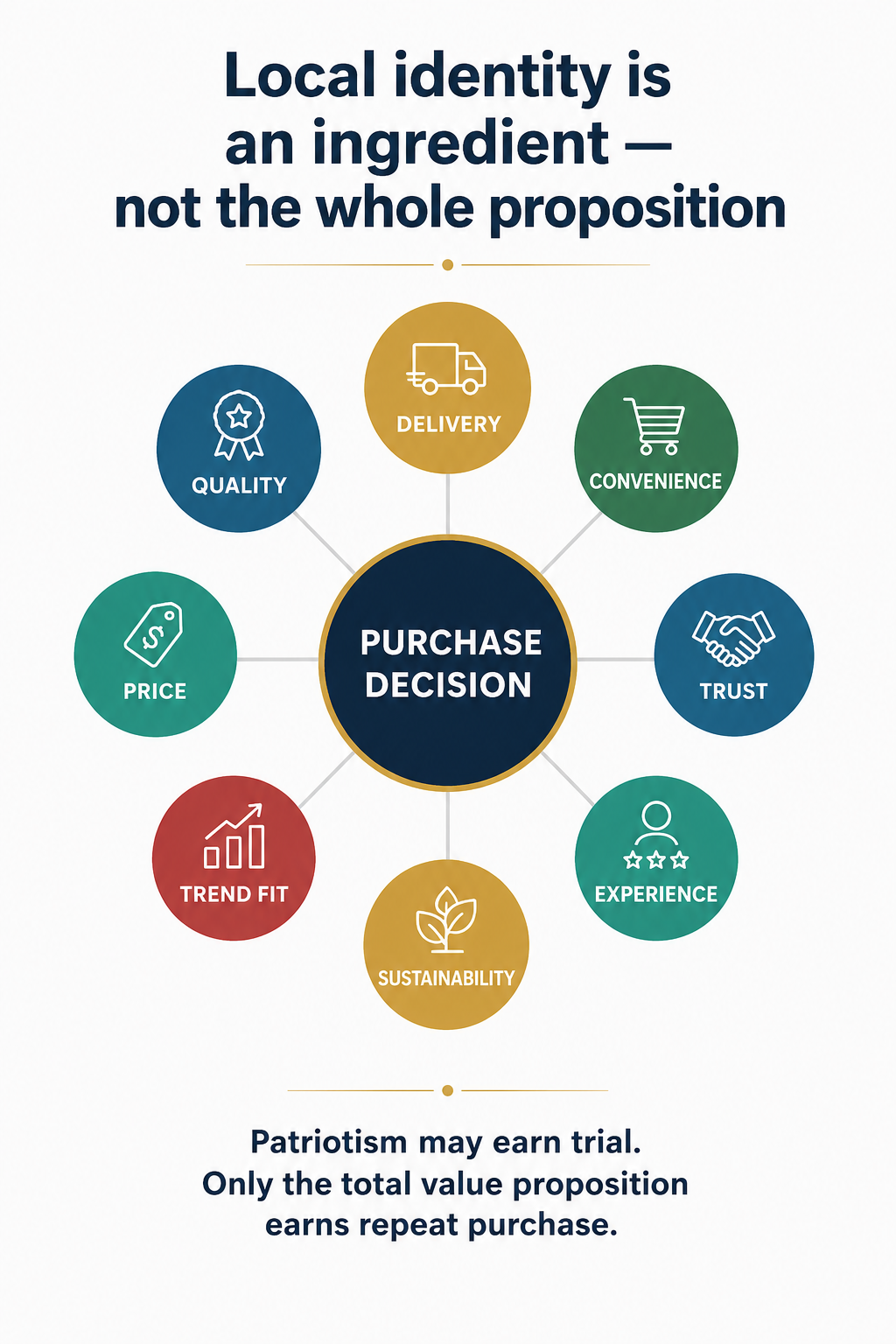
Figure 2. The consumer choice-mix
Source: Oriental Strategy and Analytics’s framework; informed by PwC (2023, 2025) and Eurostat (2026).
The implication is uncomfortable but useful: patriotism may attract the first purchase; only excellence creates the second. Family firms should therefore measure repeat purchase, fulfilment reliability, complaint resolution, stock availability and customer lifetime value—not merely brand awareness or local sentiment.
References
1. Agu, G.A. et al. (2025) ‘Indigenous Igbo Entrepreneurship Scheme: Relevance, Operational Dynamics and Sustainability’, Businesses, 5(1), 9. Online source
2. Agozino, B. and Anyanike, I. (2007) ‘The traditional Igbo business school and global commerce culture’, Dialectical Anthropology, 31, pp. 233–252. Online source
3. CeFEO (2025) Centre for Family Entrepreneurship and Ownership, Jönköping University. Online source
4. Eurostat (2026) E-commerce statistics for individuals. Online source
5. Irene, B.N.O. et al. (2024) ‘Entrepreneurial learning in informal apprenticeship programs: Exploring the learning process of the Igbo Apprenticeship System’, Cogent Business C Management, 11(1), 2399312. Online source
6. McKinsey C Company (2023) The secrets of outperforming family-owned businesses. Online source
7. McKinsey C Company (2026) Passing the baton: Creating value through CEO succession at family businesses. Online source
8. Nigerian Content Development and Monitoring Board (2010) Nigerian Oil and Gas Industry Content Development Act 2010. Online source
9. PwC (2023) 11th Global Family Business Survey: Transform to build trust. Online source
10. PwC (2025) 12th Family Business Survey: Reclaiming advantage. Online source
11. Times of Malta (2025) ‘Valletta’s Wembley Store to close after 101 years’, 20 August. Online source
12. Times of Malta (2026a) ‘San Ġwann’s Ambrose closes its door one last time after five decades’, 18 January.
13. World Bank (2024) Nigeria Trade Indicators 2022, World Integrated Trade Solution. Online source
14. World Trade Organization (2024) Trade Policy Review: Nigeria, WT/TPR/S/462. Online source