Governance
Nigeria 2027 Election Outlook: What the 2027 Election Could Mean for Interest Rates, the Naira, Credit and the Banking Sector
By Dr. Divine Ndubuisi Obodoechi
Nigeria 2027 Election Outlook: What the 2027 Election Could Mean for Interest Rates, the Naira, Credit and the Banking Sector
Introduction
Nigeria is entering the 2027 election cycle at an important point in its economic adjustment. Since 2023, the country has implemented significant reforms to the foreign exchange market, fuel subsidy regime, fiscal framework and monetary policy architecture. These measures have been accompanied by substantial adjustment costs for households and businesses, but they have also altered the policy environment in which the economy operates.
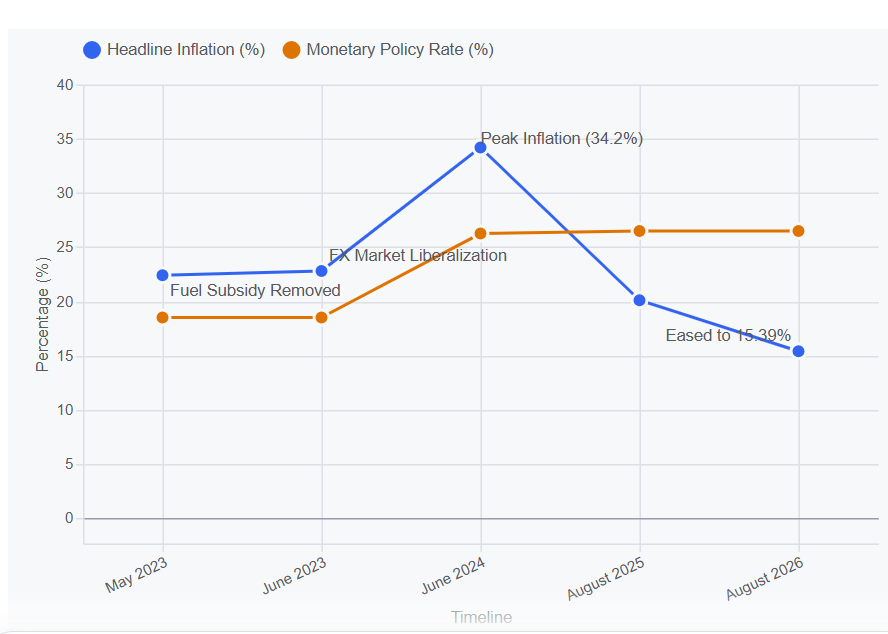
The latest inflation data suggest that the disinflation process is continuing, although food price pressures remain an important concern. The National Bureau of Statistics reported headline inflation at 15.39 percent, core inflation at 13.29 percent and food inflation at 19.57 percent in its latest available September 2026 release.
As the election approaches, the central macroeconomic question is therefore changing. It is no longer simply whether the economy is stabilise. The more important question is:
Can Nigeria sustain macroeconomic stability while responding to the economic and social pressures that typically intensify during an election cycle?
This question matters because elections influence economic expectations before votes are cast. Campaign commitments can affect expectations around government spending, taxation, subsidies, wages, exchange rate policy, interest rates and regulation. Financial markets will therefore focus not only on what political parties promise, but also on how those promises are financed and implemented.
1. From Political Event to Macro Financial Event
Political cycles matter to financial markets because markets are forward looking. Investors do not wait until a new administration takes office before reassessing economic risk. They respond to expectations about what a future government might do.
As the 2027 election approaches, financial markets are likely to focus on three broad possibilities:
· Policy continuity: existing reforms remain broadly intact.
· Policy modification: reforms continue but with greater emphasis on social protection, affordability and employment.
· Policy reversal: important elements of the current economic framework are substantially changed.
The distinction matters because Nigeria's recent reforms have affected households, businesses and financial institutions in different ways.
· At the macroeconomic level, policymakers can point to stronger policy flexibility, improved market mechanisms and progress towards restoring confidence.
· At the household level, however, the challenge is experienced through food prices, transport costs, employment, wages, housing and access to essential services.
This creates a potentially important disconnect between macro stabilisation and household affordability. That disconnect is likely to become increasingly important during the election campaign.
The policy challenge will therefore be to preserve macroeconomic stability while ensuring that economic adjustment translates into stronger household welfare, productive investment and employment.
Chart 1: Nigeria's Economic Reforms and Disinflation Cycle (2023-2026)
Source: NBS
2. Interest Rates: The Election Could Complicate Monetary Easing
Interest rates are likely to be one of the most important channels through which election related developments affect financial markets.
Under normal circumstances, declining inflation and greater exchange rate stability could create room for gradual monetary easing. However, the approach to an election could complicate this process.
Election periods can generate pressure for increased government expenditure, stronger social interventions and greater support for households and businesses. The economic impact will depend significantly on how such interventions are financed.
If additional spending is financed through stronger revenue mobilisation and expenditure reprioritisation, the inflationary consequences could be more manageable. If instead spending is financed primarily through additional borrowing or excessive monetary accommodation, liquidity and inflation pressures could increase.
This creates a policy dilemma for the Central Bank of Nigeria.
Businesses and households generally benefit from lower borrowing costs. However, CBN must simultaneously consider inflation expectations, liquidity conditions, exchange rate stability and the credibility of monetary policy.
The critical question is therefore not simply: Will interest rates fall?
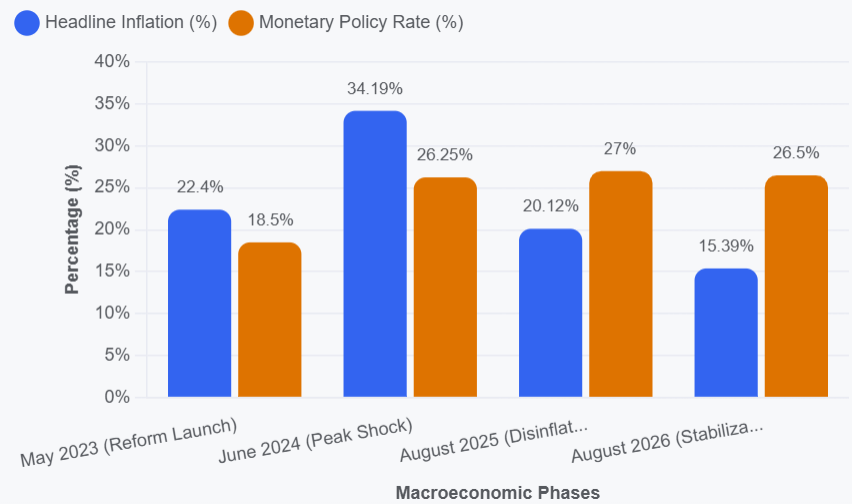
Our base case is for monetary policy to remain cautious as the election approaches. Even if inflation continues to moderate, CBN may prefer a gradual easing process rather than a rapid reduction in policy rates.
Chart 2: Nigeria’s Macroeconomic Shift: Inflation Versus Monetary Policy Rate (2023-2026)
Source: CBN
3. FX Outlook: The Naira as a Barometer of Confidence
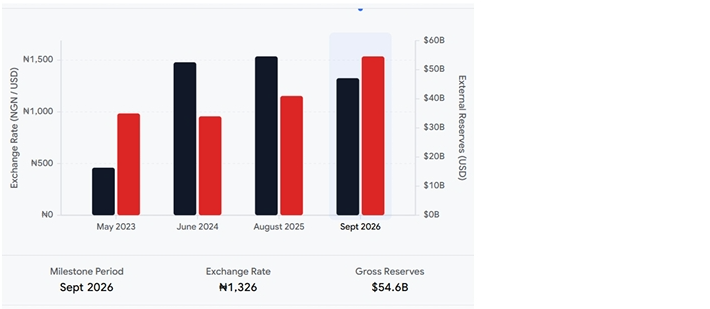
The foreign exchange market is likely to be one of the most visible indicators of election-related uncertainty. The naira is influenced by several fundamental factors, including oil receipts, foreign reserves, remittances, portfolio flows, domestic liquidity, FX market liquidity and investor confidence.
During an election cycle, expectations can become equally important. A credible commitment to macroeconomic stability and policy continuity could support confidence.
Conversely, campaign proposals that create uncertainty around fiscal policy, subsidies, exchange rate arrangements or capital movement could increase demand for foreign currency.
The key distinction is between volatility and disorder.
Election related volatility does not necessarily imply a disorderly adjustment in the FX market. If reserves remain adequate, FX liquidity remains available and monetary policy remains credible, temporary periods of pressure can potentially be absorbed.
Greater risk would arise if political developments weaken confidence in the broader economic framework.
Chart 3: Naira and Foreign Reserves (2023 – 2026)
Source: CBN, NBS & Zenith Research
4. Fiscal Policy: The Missing Link in the Election Debate
One of the most important issues to monitor ahead of 2027 will be fiscal policy. Election campaigns naturally increase attention on infrastructure, employment, social programmes, wages, food security, healthcare and other forms of public spending.
The economic impact will depend less on the existence of spending itself and more on its scale, financing and productivity.
A government can increase spending without necessarily creating macroeconomic instability if spending is supported by sustainable revenues and directed towards productive investment. The risk becomes greater when expenditure expands faster than revenue without a credible financing framework.
This makes government borrowing costs an important indicator for the banking sector.
Chart 4: Government Securities and Interest Rates
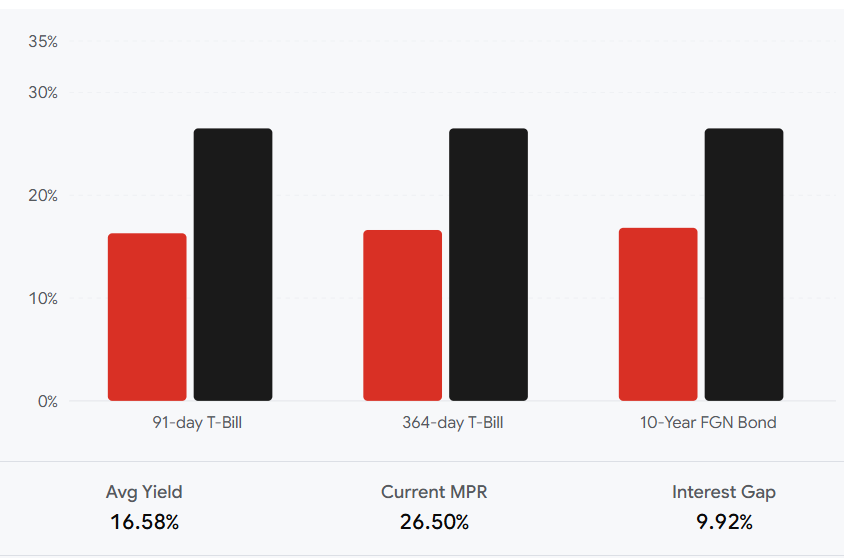
*Black bar is MPR, while red bar is the TBils
Source: DMO, CBN & Zenith Research
5. Credit: From Broad Expansion to Selective Lending
The election cycle could also influence the availability and pricing of credit. Banks typically become more cautious when uncertainty increases. This does not mean that lending stops rather, the criteria for lending become more stringent. Businesses with strong cash flows, low leverage and resilient demand may continue to access financing.
Businesses exposed to weak consumer demand, high FX costs, government payment delays or elevated refinancing requirements could face greater scrutiny. This suggests that credit growth could become increasingly differentiated across sectors. Agriculture, manufacturing, infrastructure, energy, logistics and selected consumer sectors may present different opportunities and risks depending on policy direction and economic conditions.
6. Manifesto Economics: Different Routes to Growth
The economic debate surrounding the 2027 election should be assessed through the lens of policy design, financing and implementation rather than partisan preference. The three political platforms considered in this article present different emphases.
APC: Continuity and Macroeconomic Reform
· The APC's documented economic platform places emphasis on maintaining a sound macroeconomic policy environment, strengthening financial confidence and preserving CBN independence, alongside infrastructure, job creation and broader economic development.
· From a financial market perspective, policy continuity can reduce uncertainty where investors believe existing reforms are improving macroeconomic conditions. The key issue for markets would therefore be whether continuity is accompanied by continued fiscal discipline, inflation control and further improvements in the investment environment.
Market questions
· Interest rates: Can inflation continue to moderate sufficiently to allow gradual easing?
· FX: Can market-based reforms continue to improve confidence and liquidity?
· Credit: Can lower inflation and greater macroeconomic stability eventually support stronger private sector borrowing?
Key risk
A significant pre-election increase in fiscal expenditure without corresponding revenue improvement could create pressure on inflation, borrowing costs and FX.
ADC: Reform with Greater Emphasis on Welfare and Production
· The ADC's 2027 policy framework places emphasis on citizen focused governance, structural reform, fiscal responsibility, living wages and a transition towards a production driven economy.
· Its manifesto also proposes regional value chains linking agriculture, manufacturing, logistics, technology and services.
· The economic question for financial markets would be how these objectives are financed and implemented.
· A framework that combines stronger revenue mobilisation, expenditure efficiency, productive investment and targeted social protection could potentially support both welfare and macroeconomic stability.
The critical variables would therefore be financing, implementation capacity and the treatment of inflationary and fiscal risks.
Market questions
· Interest rates: Would higher social and wage spending be accompanied by productivity and revenue improvements?
· FX: Would stronger domestic production reduce import dependence and FX pressures?
· Credit: Could regional value chains create additional demand for agricultural, manufacturing and SME financing?
Key risk
If affordability measures are financed primarily through borrowing or monetary expansion, inflation and FX pressures could re-emerge.
NDC: Production, Enterprise and Structural Transformation
· The NDC economic narrative places emphasis on diversification, domestic production, enterprise, infrastructure, human capital and reducing dependence on imports.
· The NDC also identifies agriculture, manufacturing, SMEs, industrialisation, infrastructure and economic diversification as important priorities.
· From a macroeconomic perspective, the emphasis on production is particularly relevant to Nigeria's longer term FX challenge. An economy that imports a significant share of what it consumes remains vulnerable to external shocks and foreign exchange constraints.
· Greater domestic production could, if successfully implemented, strengthen employment, industrial capacity, export diversification and demand for productive credit.
· The critical issue for markets would again be financing.
Market questions
· Interest rates: Would investment led growth create stronger demand for credit?
· FX: Could domestic production reduce import dependence and strengthen external resilience?
· Credit: Could SMEs, manufacturing, agriculture and infrastructure become stronger sources of bankable demand?
Key risk
Large investment ambitions would need credible financing and implementation mechanisms.
Three Possible Macro Financial Pathways
Rather than predicting an election outcome, it is more useful for businesses and banks to consider how different policy environments could affect the economy.
Pathway 1: Policy Continuity
Economic reforms will broadly continue and there could be potential improvement in credit transmission and investment activity.
Pathway 2: Reform with Stronger Social Spending
Existing reforms continue, but government places greater emphasis on affordability, wages, social protection and employment. For the banking sector, opportunities could be in consumer, SME and productive sector financing, alongside closer credit monitoring
Pathway 3: Significant Fiscal Expansion or Policy Reversal
Major reforms are substantially modified or fiscal expansion accelerates without corresponding revenue improvement. For the banking sector there could be increased asset quality and liquidity risks.
The purpose of these pathways is not to forecast the election result. It is to help businesses understand the economic consequences of different policy environments.
What 2027 Could Mean for the Banking Sector
For Nigerian banks, the election represents both risk and opportunity.
· The immediate earnings environment could remain influenced by interest rates and government securities yields. However, the strategic opportunity lies in identifying the sectors and customers that will remain resilient under different economic conditions.
· Changes in liquidity, government borrowing and monetary policy could create opportunities and risks across fixed income and money markets.
· Businesses may increase demand for working capital, refinancing and FX related facilities, particularly during periods of market volatility.
· Household affordability, employment and income growth will influence consumer credit, deposits and transaction activity.
· A stronger policy emphasis on domestic production could increase financing opportunities for smaller businesses across agriculture, manufacturing, logistics, technology and services.
· Food security is likely to remain a major policy priority. Agricultural financing could therefore become increasingly important, although security, weather, logistics and price risks will remain relevant.
· The emphasis on domestic production across political platforms could support demand for working capital, equipment financing, trade finance and FX solutions.
· The election cycle may require greater monitoring of borrower cash flows, government exposure, FX liabilities, refinancing needs and sector concentration.
Conclusion
· Nigeria enters the 2027 election cycle with a macroeconomic framework that is materially different from the one that existed before the current reform phase.
· Inflation is moderating, but food price pressures remain significant. The FX market has undergone structural changes. Monetary policy remains important to the inflation outlook. Government financing needs remain critical to interest rates and liquidity. Businesses continue to adjust to a higher cost environment.
· The election will therefore test the resilience of this adjustment.
· For banks, the focus should be on liquidity, credit quality, FX exposure, customer resilience and emerging sectors of investment.
· The 2027 election should therefore not be viewed simply through the lens of politics. It should be viewed as a macro financial stress test for Nigeria's reform agenda. For Nigeria, 2027 will be more than an election. It will be a test of whether economic reform can survive the political cycle.