Market Update
From Oil Chokepoint to Digital Chokepoint: Why Hormuz Matters to Financial Markets and Nigerian Banks
By Dr. Divine Ndubuisi ObodoechiJun 23, 2026
For decades, the Strait of Hormuz has been viewed primarily as the world’s most critical oil chokepoint. Today, however, it is evolving into something much broader and potentially more disruptive: a digital and financial chokepoint with implications that extend beyond energy markets into global banking systems, telecommunications infrastructure, trade finance, and macroeconomic stability.
Recent geopolitical tensions involving Iran, coupled with discussions around imposing charges or restrictions on submarine fiber optic cables and maritime transit through the Strait, have elevated concerns among policymakers, investors, and financial institutions worldwide. The issue is no longer simply about crude oil flows. It is increasingly about the vulnerability of the global economic system itself.
The implications are particularly important for emerging economies like Nigeria and for Nigerian financial institutions with growing exposure to global trade, digital payments, correspondent banking, and international capital markets
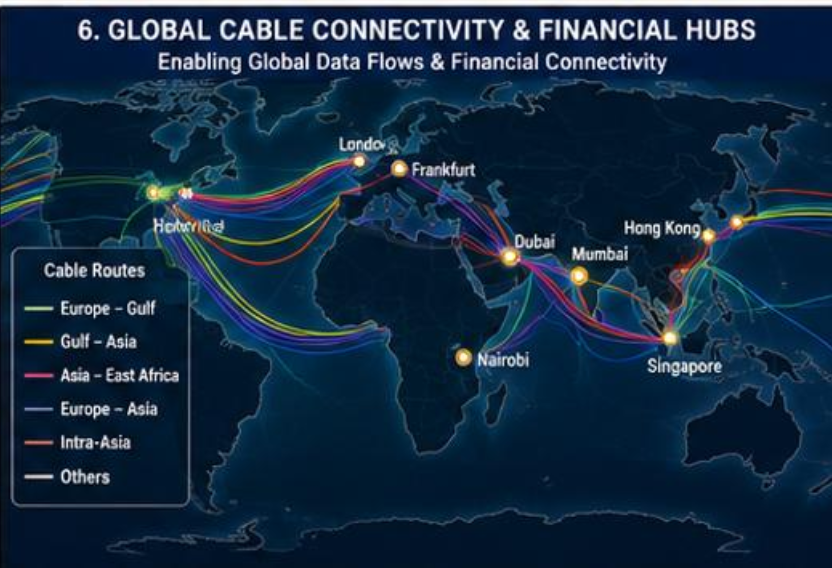
Global Cable Connectivity & Financial Hubs Around the World
Source: Telegeography
Submarine Fiber Optic Cables around the Strait of Hormuz
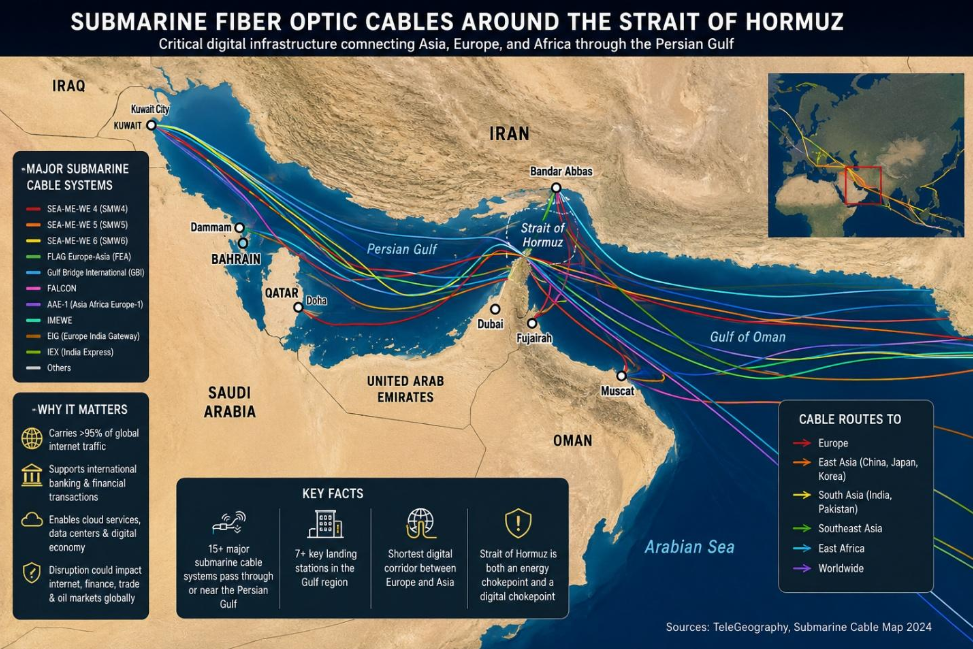
Source: Telegeograph
The Strategic Importance of the Strait of Hormuz
The Strait of Hormuz is a narrow maritime passage connecting the Persian Gulf to the Gulf of Oman and the Arabian Sea. Despite being only about 29 nautical miles wide at its narrowest point, it carries one of the highest concentrations of global energy and shipping traffic anywhere in the world.
According to the International Energy Agency (IEA), approximately 20 million barrels of crude oil and petroleum products transit through the Strait daily, representing nearly 20% of global oil consumption and roughly one quarter of global seaborne oil trade.
The Strait is also critically important for global gas markets. Around 20% of global LNG trade passes through Hormuz, with Qatar accounting for a major share of those exports.
Beyond energy, the region hosts major submarine fiber optic cable systems that connect Europe, the Gulf, Asia, and parts of Africa. These cables support:
- International banking transactions
- Cloud computing services
- Global internet traffic
- Cross-border payment systems
- Financial messaging infrastructure
- International business operations
This dual role as both an energy artery and digital infrastructure corridor explains why the Strait has become one of the most systemically important geopolitical hotspots globally.
From Energy Risk to Digital Risk
Historically, disruptions in Hormuz primarily translated into oil price spikes. Today, the risks are more multidimensional.
Iranian officials and affiliated media have recently discussed leveraging control over strategic infrastructure in the region, including undersea cable routes and maritime transit systems.
This introduces a new layer of risk: the possibility that geopolitical tensions could affect not just physical energy flows but also global digital connectivity and financial communications.
Submarine cables are estimated to carry over 95% of global internet traffic and a substantial share of international financial data transfers. A disruption in this network could affect:
- SWIFT-related communications
- Cross-border payment settlements
- Global FX transactions
- Digital banking services
- Cloud-based financial systems
- International trade execution
In effect, Hormuz is gradually transforming from an “oil chokepoint” into a “digital chokepoint.”
Implications for the Global Economy
- Inflationary Pressure: Any sustained disruption in Hormuz would likely push oil and gas prices significantly higher. Recent tensions have already contributed to Brent crude prices rising above $110 per barrel in some scenarios. Higher energy prices transmit into the global economy. This could prolong global inflationary pressures and complicate monetary policy decisions for central banks.
- Supply Chain Disruptions: Around 100 cargo vessels transit Hormuz daily under normal conditions. Import-dependent economies would be especially vulnerable
- Financial Market Volatility: Markets react sharply to geopolitical uncertainty around Hormuz because of its outsized influence on energy and trade flows. Potential market consequences include higher bond yields, equity market selloffs, currency volatility, flight to safe-haven assets and increased commodity speculation. Oil-importing nations across Asia and Europe could face significant balance-of-payments pressures.
Why This Matters to Nigeria
For Nigeria, the effects are mixed and highly consequential
Potential Upside for Nigeria
Higher oil prices may improve government revenue, FX inflows, external reserves, fiscal balances and oil sector earnings. Since crude oil remains Nigeria’s largest export earner, elevated prices could temporarily support macroeconomic stability and strengthen public finances.
The Negative Spillovers
However, the benefits are unlikely to be entirely positive. Nigeria remains highly exposed to imported inflation due to dependence on imported refined petroleum products, high transportation costs, FX sensitivity and imported industrial inputs. Higher oil prices could therefore worsen domestic inflation, food prices, energy costs and logistics expenses. Additionally, disruptions to global digital infrastructure or international payment systems could affect Nigeria’s financial connectivity and international trade operations.
Implications for the Nigerian Banking Sector
The implications for Nigerian banks are significant and multifaceted.
- Treasury and Financial Markets Exposure: Periods of Hormuz-related instability tend to increase volatility across oil markets, foreign exchange markets, sovereign bond markets and equity markets. Banks with active treasury operations may face increased market risk, liquidity pressures, higher funding costs and greater FX volatility. At the same time, elevated oil prices could improve liquidity within the Nigerian economy and support banking sector deposits linked to oil- related inflows.
- Credit Risk Pressures: Industries likely to face cost pressures include manufacturing, aviation, telecommunications, logistics, consumer goods and power and energy-intensive sectors. Higher operating costs could weaken debt- servicing capacity among borrowers, increasing non-performing loan risks within affected sectors.
- Digital Banking and Operational Resilience: Perhaps the most underappreciated risk is operational resilience. If geopolitical tensions escalate into disruptions affecting submarine cable infrastructure, banks could face:
- Slower transaction processing
- Connectivity interruptions
- Increased cyber risk
- Delays in international settlements
- Higher dependence on backup systems
As Nigerian banks become increasingly digital and globally connected, infrastructure resilience is becoming as important as capital adequacy.
Conclusion
The Strait of Hormuz is no longer merely an oil transit corridor. It is increasingly a convergence point for energy security, digital infrastructure, financial stability, and geopolitical power projection. What happens in Hormuz now has implications not only for crude oil prices but also for internet connectivity, cross-border banking, payment systems, inflation dynamics, trade flows, and financial market confidence.
For Nigeria and the Nigerian banking sector, the risks are both direct and indirect. While higher oil prices may temporarily support government revenues and FX inflows, the broader consequences of prolonged geopolitical instability could amplify inflationary pressures, financial market volatility, operational risks, and credit vulnerabilities.
In this evolving landscape, resilience, diversification, and proactive risk management will increasingly determine which financial institutions are best positioned to navigate the next phase of global geopolitical uncertainty.