Analysis
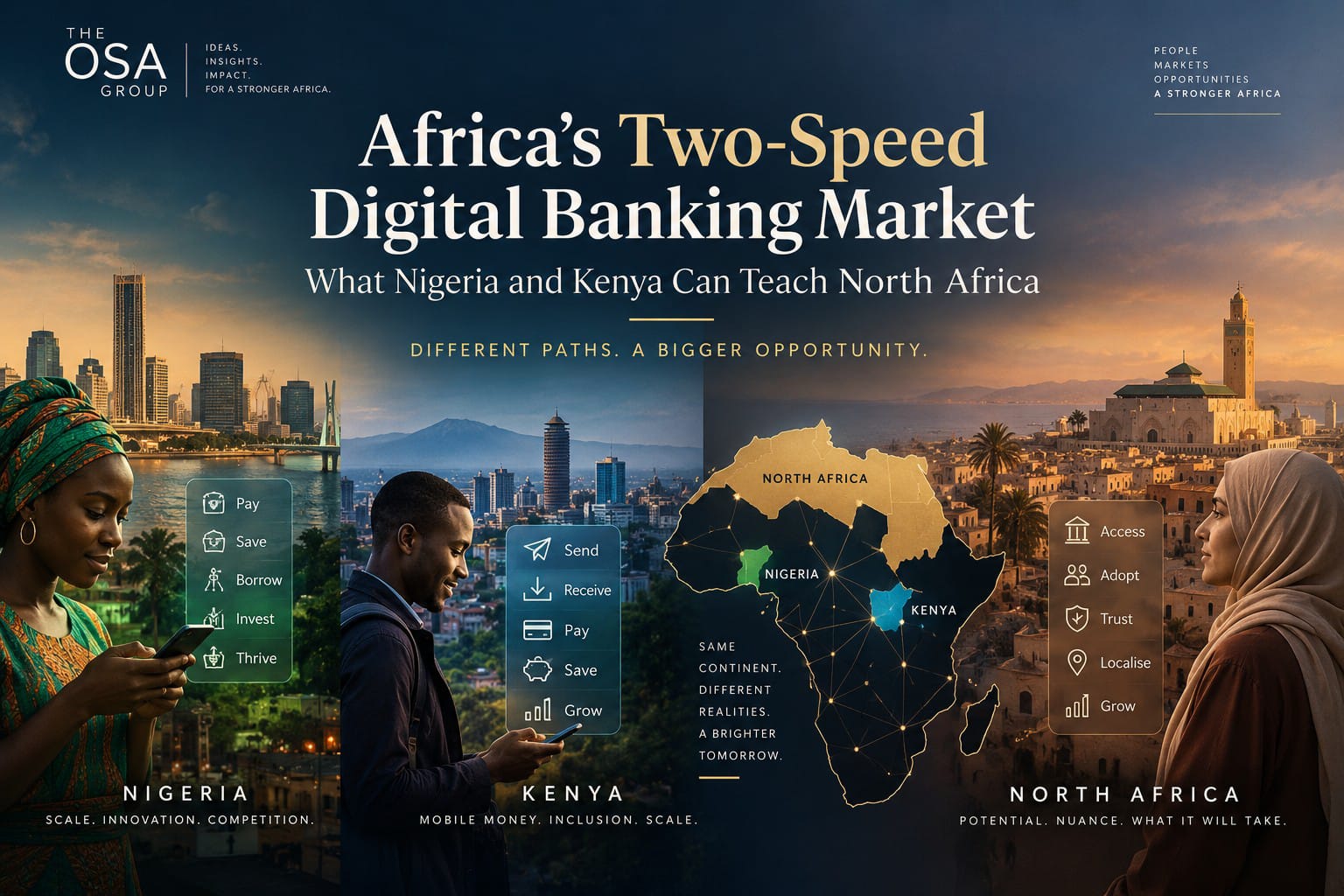
Africa’s Two-Speed Digital Banking Market: What Nigeria and Kenya Can Teach North Africa
By IfunanyaChukwu Onyema-NwankwoSep 28, 2026
Africa’s Two-Speed Digital Banking Market: What Nigeria and Kenya Can Teach North Africa
Nigeria and Kenya demonstrate two different models for building a digital financial ecosystem. As North Africa accelerates its own transition, banks and fintechs looking north will need to recognise that the opportunity is not simply to export what worked elsewhere. It is to understand why it worked—and redesign the model around a very different consumer, regulatory and cultural environment.
Africa's digital-finance story is often told as though it were a single continental transformation. It is not.
Across parts of Sub-Saharan Africa, financial services have moved rapidly from branches and cash towards mobile money, digital payments, fintech applications and increasingly sophisticated digital banks. Kenya and Nigeria sit near the centre of this transformation, although they arrived there through markedly different paths.
North Africa presents a different picture. Digital adoption is advancing, sometimes rapidly, but cash remains unusually resilient in several markets and the route from owning a bank account to actively using digital financial services remains less straightforward.
This divergence matters.
For African digital banks seeking their next growth market, and for traditional banks deciding where to place their digital bets, North Africa represents both an attractive frontier and a warning against assuming that Africa's most successful digital-finance models can simply be replicated across borders.
The strategic question is therefore not whether North Africa will digitise. It is what form that digitisation will take, who will capture it, and which institutions will adapt their models quickly enough to participate.
Two digital-finance leaders, two very different journeys
Kenya's digital-finance story was built primarily from the mobile phone outward.
Nigeria's was built increasingly from the banking and payments infrastructure outward.
That distinction helps explain the shape of the two markets today.
Kenya's transformation is inseparable from mobile money. By 2024, formal financial access had reached 84.8 percent of adults, compared with 83.7 percent in 2021, while the financially excluded population had fallen to 9.9 percent. Mobile money remains the principal driver of that inclusion.[1]
The significance extends beyond access. The widespread use of mobile money created a financial infrastructure on which savings, lending, merchant payments, remittances and other digital products could subsequently develop.
The World Bank's Global Findex research illustrates the depth of this behaviour. Among Kenyan account holders, making digital payments has become close to universal—an important distinction between merely possessing an account and actually incorporating digital finance into everyday economic activity.[2]
Kenya consequently offers perhaps Africa's clearest example of behaviour-led financial digitisation: consumers learned to transact digitally first, creating a market into which increasingly sophisticated financial products could be introduced.
Nigeria's evolution has been different.
Africa's largest economy developed an increasingly competitive ecosystem of commercial banks, payment-service providers, switches, fintechs, agency-banking operators and digital-first financial platforms.
The regulatory architecture evolved alongside that ecosystem. The Central Bank of Nigeria's Payments System Vision 2025 explicitly promoted electronic payments, interoperability, QR codes, open banking, digital identification and the entry of new products and participants into the payments ecosystem.[3]
That direction has subsequently been extended. In June 2026, the CBN introduced its Payments System Vision 2028, organised around interoperability, security, inclusion, innovation, trust and collaboration, with greater emphasis on cross-border integration and international standards.[4]
Nigeria's model therefore resembles an increasingly dense digital financial marketplace.
Consumers can move among bank apps, wallets, payment companies, digital lenders, agent networks and fintech platforms. Competition increasingly takes place not around access to a bank branch, but around the quality, cost, reliability and breadth of the digital financial experience.
Nigeria and Kenya consequently illustrate two powerful but distinct African models:
Kenya demonstrates what happens when mobile money becomes financial infrastructure. Nigeria demonstrates what happens when fintech competition becomes financial infrastructure.
The distinction matters because neither model can automatically be exported north.
The adoption gap is no longer simply about technology
The difference between leading African digital-finance markets and slower-adopting markets is becoming increasingly difficult to explain through smartphone penetration or internet access alone.
The larger issue is behavioural and institutional.
Across Africa, mobile money has been one of the most important drivers of financial inclusion. In Sub-Saharan Africa, 33 percent of adults already had a mobile-money account by 2021.[5]
North Africa has historically looked very different.
World Bank analysis found that only around 5 percent of adults in North African countries where mobile money was available had a mobile-money account as of 2022. Digital payments among existing account holders were considerably more common, but the region exhibited an important behavioural characteristic: receiving money digitally was more prevalent than making digital payments.[6]
This suggests an important distinction.
Digital access does not necessarily produce digital behaviour.
A consumer can have a bank account, debit card and smartphone and still withdraw most incoming funds as cash.
That distinction is visible in individual North African markets.
Morocco: infrastructure is advancing faster than behaviour
Morocco illustrates the paradox particularly well.
The country's banking and telecommunications infrastructure gives it many of the ingredients required for digital finance. Yet World Bank 2024 data indicate that only 34.9 percent of surveyed adults had made or received a digital payment.[7]
More revealing is how consumers behave once digital alternatives are available.
Among surveyed Moroccan bank-account holders, only 32.5 percent reported using a card or mobile phone to access the account for payments, purchases, or sending or receiving money.[8]
The underlying obstacle is not purely technological.
In the World Bank's 2024 Morocco sample of people who only used cash for in-store merchant payments, 66.3 percent cited being accustomed to paying in cash as their main reason. Merchant acceptance was another constraint, cited by 21.8 percent.[9]
Those figures should be read cautiously as survey-sample results rather than population estimates. But strategically, the signal is significant.
A digital bank entering Morocco is not simply competing against incumbent banks.
It is competing against habit.
And habit is often a stronger incumbent than a financial institution.
Egypt: rapid progress, but a different adoption pathway
Egypt shows why North Africa should not itself be treated as one homogeneous market.
Account ownership has risen substantially. World Bank data put adult account ownership at 43.1 percent in 2024, up from 27.4 percent in 2021. The share making or receiving digital payments rose to 36.3 percent from 20.2 percent over the same period.[10]
Mobile money ownership has also expanded, while Egypt's Instant Payment Network and InstaPay have created important new digital-payment infrastructure.
Yet the behavioural transition remains incomplete.
The World Bank's 2024 survey found that only 29.5 percent of surveyed bank-account holders had checked their balance using a mobile phone or computer during the preceding year.[11]
Perhaps more importantly, many consumers appear to enter the formal financial system for a specific functional reason rather than because they actively seek a banking relationship. Among surveyed account holders, 72.3 percent reported that their first account had been opened to receive wages, salary or government money.[12]
This creates both a challenge and an opportunity.
The challenge is that account acquisition does not guarantee engagement.
The opportunity is that banks already possess an entry point into the customer's financial life.
The commercial battle therefore moves from account acquisition to account activation.
North Africa's digital-finance gap is an opportunity—but not a blank canvas
It would be tempting to look at lower digital usage and conclude that North Africa simply represents an earlier version of Kenya or Nigeria.
That interpretation would be misleading.
The region has its own banking structures, payment systems, regulators, postal networks, informal economic activity, consumer expectations and cultural characteristics.
The next phase of digital finance is therefore unlikely to come from importing a West or East African template unchanged.
Banks need a localisation strategy.
We see six strategic priorities.
1. Sell a use case before selling a digital bank
Consumers rarely adopt financial technology because they want "digital banking".
They adopt it because it solves something.
Kenya's mobile-money revolution solved the problem of moving money conveniently. Nigeria's fintech ecosystem has increasingly competed around faster transfers, merchant payments, savings, credit and easier financial management.
North African expansion should begin with the same question:
Which recurring financial friction are we removing?
Depending on the market, the answer might be salary access, domestic transfers, remittances, bill payment, SME collections, merchant payments, savings or cross-border commerce.
The product should then expand around that initial use case.
This is considerably more defensible than launching a broad digital bank and expecting consumers to migrate simply because the interface is better.
2. Design for coexistence with cash
In markets where cash remains culturally and commercially embedded, a strategy designed to eliminate cash immediately is likely to create unnecessary friction.
The better approach is to build bridges between cash and digital finance.
That means considering agent networks, merchant cash-in and cash-out, ATM interoperability and other mechanisms that allow consumers to move comfortably between physical and digital money.
The strategic objective should initially be migration rather than substitution.
Every successful digital transaction creates another opportunity to build familiarity and trust. Over time, the digital share of the customer's financial activity can increase.
Trying to force the entire transition at onboarding may instead discourage adoption.
3. Treat trust as product infrastructure
Digital finance is unusually dependent on trust because the product itself is largely invisible.
Consumers are being asked to exchange tangible cash for numbers on a screen and to trust that those numbers will remain accessible tomorrow.
That means cybersecurity, dispute resolution, fraud prevention and customer support should not be viewed solely as compliance functions.
They are customer-acquisition capabilities.
This is particularly important in markets where consumers have longstanding relationships with incumbent banks, postal institutions or cash-based networks.
A new entrant may therefore need visible reassurance: transparent pricing, rapid complaint resolution, local customer service, credible institutional partnerships and physical points of presence.
For traditional banks, this can be an advantage.
Their legacy branch networks—frequently characterised as liabilities in digital transformation programmes—can become trust infrastructure supporting digital adoption.
4. Localise beyond language
A French or Arabic interface is localisation at its most superficial.
Real localisation extends into product design.
North Africa contains multiple linguistic, cultural and commercial environments. Arabic may need to coexist with French, English and local language preferences. Customer-support expectations vary. Informal merchants operate differently from salaried workers. Rural financial behaviour can differ substantially from that of consumers in Casablanca, Cairo or Tunis.
Religious considerations also matter.
Islamic-finance principles influence the financial preferences of segments of consumers across North Africa. A bank does not necessarily need to become an Islamic bank to enter these markets, but it should understand where product structures, terminology and particularly interest-based propositions may affect adoption.
The broader lesson is straightforward:
Translation changes the interface. Localisation changes the proposition.
5. Use partnerships to enter ecosystems that already possess trust
A digital bank does not necessarily need to build every distribution channel itself.
In fact, doing so may be strategically inefficient.
Telecommunications operators, retailers, postal networks, employers, utilities, government-payment systems and incumbent banks already control valuable customer relationships.
Partnership can therefore become a market-entry mechanism.
Egypt offers a useful illustration of the power of payment infrastructure. Its Instant Payment Network demonstrates how interoperable infrastructure can create new digital behaviours without requiring consumers to abandon the banking system altogether.[6]
Similar logic can apply commercially.
Rather than asking, "How do we acquire one million customers?", entrants should ask:
Which institution already interacts financially with one million potential customers?
That shift can dramatically change customer-acquisition economics.
6. Build the merchant side at the same time as the consumer side
Consumer wallets have limited value if consumers cannot use them.
This is one of the most important lessons from the uneven development of digital payments globally.
The World Bank notes that merchant-payment digitalisation can both expand account usage and help businesses build transaction histories that can later support access to formal credit.[13]
For banks, this creates a potentially powerful flywheel.
Digitise merchant collections.
Generate transaction data.
Use that data to understand cash flow.
Use cash-flow visibility to improve credit assessment.
Offer working capital.
Increase merchant dependence on the platform.
At that point the institution is no longer simply providing payments. It is becoming financial infrastructure for the business.
This may prove particularly important across North Africa's large SME and informal-business sectors.
From digital banking to digital financial ecosystems
The most important lesson from Nigeria and Kenya may ultimately have little to do with any particular app or technology.
Their development demonstrates that digital-finance adoption accelerates when an ecosystem begins reinforcing itself.
Consumers attract merchants.
Merchants create more reasons for consumers to transact digitally.
Transaction histories improve financial data.
Better data enables lending and other financial products.
More products increase the value of remaining within the ecosystem.
That cycle is difficult to manufacture through a standalone banking application.
It requires interoperability, regulation, infrastructure, distribution, trust and commercially useful products to develop together.
North Africa is already moving in this direction. Egypt's payment infrastructure is expanding. Morocco is building a more developed digital-finance ecosystem. Tunisia and other markets continue to explore digital mechanisms for broadening financial inclusion. Across the wider continent, fast-payment infrastructure is spreading.
The opportunity therefore is not based on the assumption that North Africa has failed to digitise.
It is based on the fact that the region's next stage of digitisation remains open to competition.
For Nigerian and Kenyan financial institutions, that presents an intriguing possibility. The capabilities built in two of Africa's most demanding digital-finance markets—high transaction volumes, mobile-first architecture, alternative distribution, payments technology and rapid product iteration—could become valuable exports.
But technology will be the easier part to export.
The harder task will be exporting the operating capability while leaving the original assumptions behind.
The winners in North Africa are unlikely to be the institutions that simply replicate Nairobi or Lagos.
They will be those that understand Casablanca, Cairo, Tunis and the markets around them on their own terms.
And that distinction may define the next chapter of Africa's digital-banking story.
References
- Central Bank of Kenya, Kenya National Bureau of Statistics, & Financial Sector Deepening Kenya. (2024). _2024 FinAccess household survey_.
- Central Bank of Nigeria. (2022). _Nigeria payments system vision 2025_.
- Central Bank of Nigeria. (2026). _Nigeria payments system vision 2028_.
- World Bank. (2025a). _Financial inclusion in Africa: Progress, challenges, and the road ahead_. World Bank.
- World Bank. (2025b). _The Global Findex database 2025: Connectivity and financial inclusion in the digital economy_. World Bank.
- World Bank. (2025c). _The Global Findex database 2025: Egypt, 2024 microdata_ [Data set]. World Bank Microdata Library.
- World Bank. (2025d). _The Global Findex database 2025: Morocco, 2024 microdata_ [Data set]. World Bank Microdata Library.
- World Bank. (2025e). _The little data book on financial inclusion 2025_. World Bank.